The turbulent 1930s
The great depression that began with the Wall Street crash in the USA and the Kreuger crash in Sweden formed the backdrop of the turbulent 1930s, when ideologies, politics, aesthetics and territories became the subjects of heated conflicts. Politicians and artists fought for supremacy in the cultural field. This led to censorship measures by the state and style wars in the arts.In Sweden, architects and artists were still trying to liberate themselves from the dominant national romantic style. The Stockholm Exhibition in 1930 was a powerful step in that direction, finally introducing post-cubist artists such as Léger, Moholy-Nagy and Mondrian and the architect Le Corbusier’s ideas on a functionalist city for the “new man”.
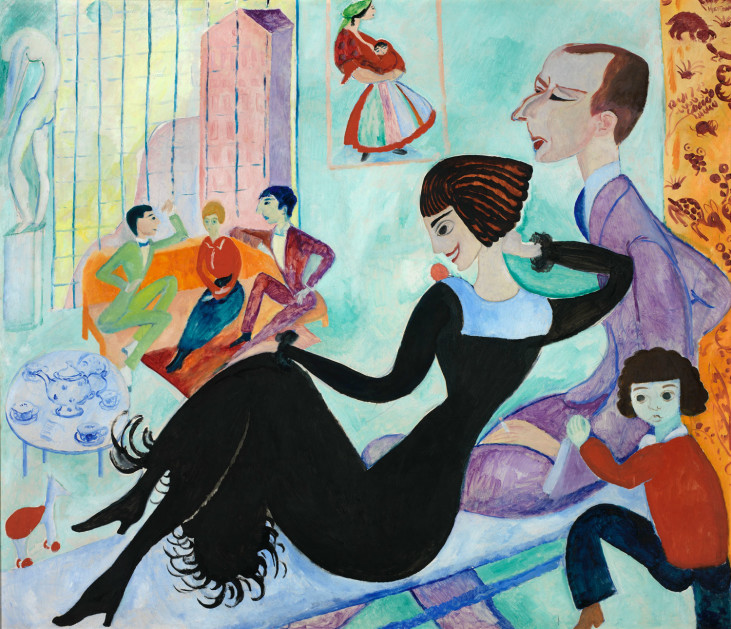
Vera Nilsson
Lampsken, ca 1930
© Vera Nilsson/BUS 2012
But modernism was not a homogeneous movement. There was widespread scepticism against utopian systems. Among the abstract paintings and terse architectural models at the Stockholm Exhibition, many artists asked where this “new man” had disappeared. Vera Nilsson, Sven Erixson, Albin Amelin, Siri Derkert and others pinned their hopes on the individual, and based their artistic practices on a humanist approach.
Their portraits and scenes imbued with social relevance were a stand against what they perceived as a new academism. Their protest was enhanced by an open style and a DIY aesthetic that is also found in later protest movements, such as punk. Nearly all the artists in this room exhibited at the artist-run gallery Färg och Form. Today, they are sometimes described rather arbitrarily as an extension of 1920s idyllic naivism, but their works were neither naive nor innocent.