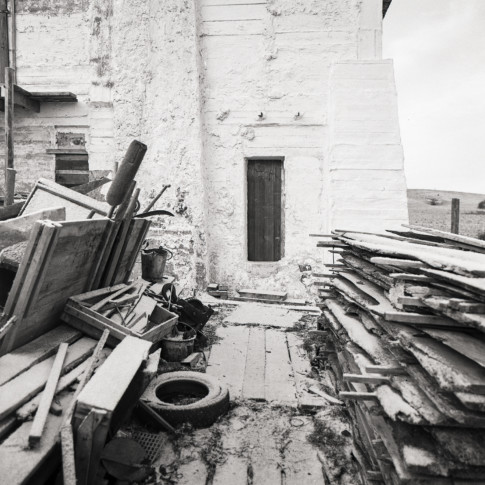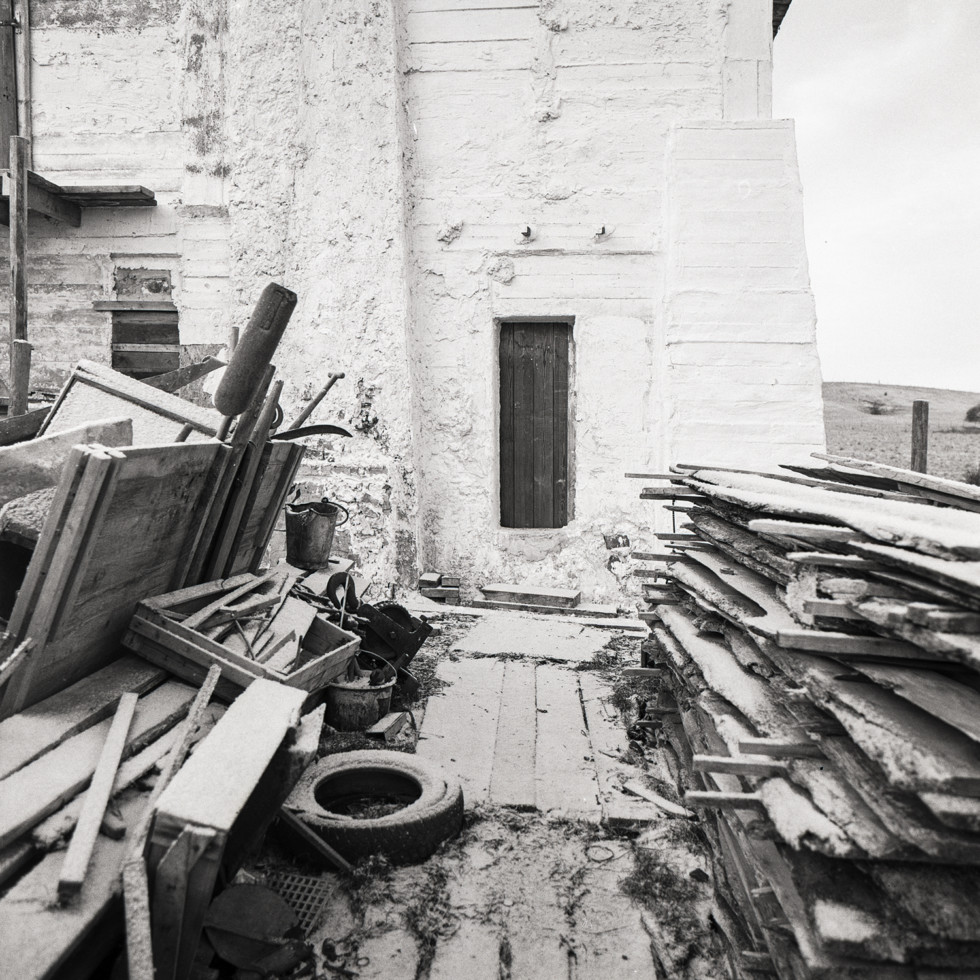
John Skoog, REDOUBT, Documentation from reconstruction, winter, 2023 Photo: David Skoog
REDOUBT – Publication
Many years ago I was living in a village in the Hungarian countryside. The landscape there is flat, at most ever so gently undulating. Small towns or villages are few and far between. The roads are lined with acacia trees, and here and the fields are interspersed with little copses around the overgrown ruins of long abandoned cottages. There’s a lot of sky and horizon in all directions. To one side of my garden, I had odd neighbours. They were a pair – sister and brother in fact – but considered themselves a couple. They seemed old to me but at the same time ageless, like characters in strange and lesser known fairy tales. The man was hunched, probably from lugging heavy sacks of potatoes all his life. The woman was small and thin, childlike almost, she wore her hair in plaits and usually dressed in frilly pinafores, the starched ruffles on her shoulders almost touching her earlobes. On warm evenings in spring and summer, she’d sit with the other women in our street on a bench outside and dangle her spindly short legs while they were chatting and singing and commenting on the people who cycled past. My neighbours grew potatoes for a living, year in, year out. Only once, when there had been a particularly bad blight and the money they had to spend on pesticides outweighed any profits, they opted for corn which grew into a tall, rustling, whispering forest of browning stalks in the course of the hot summer. But they had other fields, too, and come what may, three times a week they pulled a cart laden with potatoes to the market. The man was a gatherer and hoarder, incapable of leaving an item lying by the roadside that could still, perhaps, one day, be put to use, and be it as a piece of kindling. Over the years I had to knock on their gate on two or three occasions when there had been storm damage to the boundary fence. They cautiously opened the gate and I caught a glimpse of their yard. At the far end there was an enormous amount of materials stacked and lined up neatly, in order of kind, shape and size. There were broken bean poles, roof beams, cart wheels, and cracked wooden basins for pig’s blood, an indispensable item in the slaughtering season.There were pails, tyres, bricks, roof tiles, wire, pieces of broken machinery and sheets of corrugated metal and plastic. But the most striking feature of this assembly and indeed the entire yard, including the small flock of desultory hens, was its greyness. Grey was the only colour, or rather it was more like a uniform absence of colour, as if the place was under a spell and waiting for a magic wand to turn it into Munchkinlandish Technicolor. But there was no wizardry at hand, no one to apply their tricks and transform the stifling spectacle of the grey siblings positioning themselves against the backdrop of this orderly display of brokenness, as if trying to shield their treasure from view. This was the ultimate Kansas. No one would dare enter this yard, I thought, for fear of turning grey themselves.
I don’t think any of the salvaged material was ever put to use, not even as kindling or fire wood. Like many people in my street, the siblings too liked heating with the ubiquitous plastic bottles – “they give off such good heat”, was the standard excuse for the acrid smell and blueish clouds of smoke rising from the chimneys. And, people insisted, it saved the fee for the chimney sweep and kept the flues free of soot.
Looking at the images of Karl Göran’s original project brought back the memory of my former neighbours’ grey zone – not so much because of similaritites but rather because of their dramatically different attitudes to gathering, collecting and salvaging. Both the siblings and Karl Göran, however, invite the imagination and lend themselves to ideas for film and fiction. They may even confuse the beholder and make them wonder if they’ve emerged from a book or a film. When I visited the village some time after I’d left, another neighbour told me that the pinafored sister had died, according to her brother from a “sore in her side that wouldn’t heal”. I doubt that the brother had read Kafka’s A Country Doctor between lugging sacks of potatoes, but I couldn’t help thinking of the story and wondering by which windows the doctor’s eerie horses might have looked into the sickroom.
Karl-Göran belongs into a different kind of story. He is, to begin with, a man of good intentions. He is not an owner but a maker, he hoards with a vision: selfless and determined. He is a gatherer, a gleaner who recognizes a dormant potential in every object. Looking at the arc of his life – peasant boy – soldier – self appointed saviour – we squint into the sun of times gone by and make out the shape of a hero.
I remember a trip through the undulating countryside of Skåne many years ago. There were large fields, dirt roads, copses, tall single trees – perhaps ash trees or elms. I remember the rows of stunted willows lining paths between fields below street level – a familiar sight from the wintry and foggy landscapes of the lower Rhineland where I grew up. I liked the small farms, the roses in their last autumnal bloom. Once I got lost and asked a man for directions. “Are you German?” he asked. “Yes”, I said, truthfully, although I had been living in the UK for a long time. “Don’t you have nice places in your own country?” he said. “Do you have to come here?”. He was blunt, and I was baffled, it was my first visit to Sweden and I had no intention of settling there – but at the same time the man was calm and polite and may have been honestly curious. He also may have been worried about limited space in shelters and wary of intruders into a communal dream of safety.
The villages and small towns of Southern Sweden reminded me of rural Poland in the 90s. There was something quite forlorn about them, unloved, half abandoned. Perhaps it was the flocks of youths not knowing where to put themselves for boredom in the main streets with one or two hairdressers, a tiny supermarket, a bakery and a kebab shop. A cinematic, studied desolation lingered about the places: The boarded-up shop fronts and the display of cheap sweets and tubs of instant coffee in a shop window could have been part of a film set. Soon the lights would change and the grumpy teenage boys would be handed their daily fee as extras and board a bus to go back to cosy homes with cats curled up by crackling fires and dinner waiting. What at all is real of the sights we see when passing through a foreign place? Whatever we behold of the sceneries drifting past, it instantly triggers memories which have lain dormant for years, waiting to be called by their name. The impression itself, however, is already becoming a memory in its own right, mingling with existing layers of remembered images, sounds, smells.
Karl Göran was long gone when I travelled in Sweden. People will have helped themselves to the material he had collected, they will have rummaged through his treasures and carried things away into their own yards, possibly tidy grey spaces like my Hungarian neighbours’, meticulously organized storage of potential solutions for emergencies as yet unknown. Perhaps the building survived, too sturdy to be demolished, who knows. The shell of a shelter.
Karl Göran’s story, however, lives on, and it matters. People may have taken him for a fool when he was working on his project, but fools and saints make for good stories which survive all tales of reason. Like the heroes of old, Karl Göran became a regional legend due to his physical strength. But apart from his strength, he also had a vision. One of the four million visitors to the International Exhibition in Stockholm in 1930, Karl Göran was impressed with the buildings and designs on view. A functional aesthetic, “simple and stringent” was promoted by the Swedish architect Gunnar Asplund who encouraged the public to embrace the modern style stripped of decorative elements. Functionality became an ideal and Karl Göran’s lodestar for his life’s project – the construction of a shelter that would accommodate the residents of an entire village in case of a war. World War II was still on people’s minds, but the possibilities of armed conflict were also addressed by the Swedish government. Pamphlets titled “When There Is A War” were published and distributed at irregular intervals. The pamphlets contained advice on what to stock up on, where to shelter and how protect oneself and others in case of a war. They explained the siren signals which would inform the population of the degree and type of danger. The pamphlets themselves were factual and informative without stoking fear. Karl Göran took them to heart and set to work, not with himself on his mind but the community.
I imagine Karl Göran on the lookout for materials to be salvaged and put to use. Rusty barbed wire and broken roof tiles, discarded window frames and lengths of rope. Our consumerist world is full of things languishing in forgotten corners and longing to have a new life. It takes someone with a vision or a dream – usually a child – to recognize this longing and dedicate themselves to elevating the abandoned objects to a new purpose and meaning.
I imagine Karl Göran striding and cycling down paths and country roads, stopping at farmyards and deserted railway stations and occasionally negotiating with the masters of scrapyards. Scrapyards were kingdoms unto themselves at the time, I’m sure Sweden was no different from Germany in that respect. People in Karl Göran’s village may have been puzzled at first, then amused, at some point certainly also admiring or annoyed in the face of his tenacity and determination. The shelter grew, a fortress to ward off adversity, for the entire village. They would all come and sit together and feel safe and protected, a dream so lovely, one might almost wish for a minor emergency to give it a chance to happen.
I imagine Karl Göran walking up and down the field by the side of his building and wondering what to call it. Children would find excuses to seek him out, linger by the site and make up little songs. “Hey, Karl Göran”, they called, “what’s the name of your house?” “It’s not a house”, said Karl Göran, “it’s a redoubt.”
What a proud, towering word for a building!
“What’s a redoubt?” the children called back, curious.
“This is a redoubt!”, explained Karl Göran, balancing on an unfinished wall and trying to position a roll of rusty wire mesh entangled with strands of old man’s beard and brambles. “It’s a safe place. No harm. No frills.”
“But it must have a name, Karl Göran”, insisted the children.
“Let’s say it’s called Funkis”, said Karl Göran, paying implicit tribute to Gunnar Asplund’s ideal. “Funkis. Very easy. All you have to do is come running to Funkis and everybody will be safe. ”
I wonder if I would’ve noticed Funkis in the middle of a field, in the wide open space, under a gentle autumn sky? Would it have caught my eye, would I have stopped to take a closer look? A futile question, perhaps. So many of our ways of seeing depend on our expectations, we read a landscape and the traces left in it and misread so much of it. And yet – our reading may become a story.
I know a thing or two about dreams fostered by wide open landscapes, with a lot of sky and horizon. I’ve always felt that the plains invite visions which are taller than our little lives. For others, they feed a sense of lack. They may open our eyes to the significance of every small feature or object when there’s no scenic drama to distract from it, but also to our own smallness, our desire to not just see but also to be seen and, ultimately, remembered. Unattainable and everpresent, the horizon is a melancholy boundary, reminding us of our finite lot in what seems like infinity. For some, emptiness is hard to fill with dreams, and that has not necessarily to do with hardship. In Hungary, I used to hear people talking much more about what was lacking than what was there. The vast sweeping views under a huge sky mostly brought to mind the absence of mountains, lakes, and dark forests. My neighbour hoarded to compensate for a perceived lack. His stash, all his own behind a tall fence and a locked gate, was his shelter. He had created a private lair to protect him from the vastness of the sky, the ubiquity of the horizon, the possibilities lying dormant in an empty landscape. That was his private rebound. Perhaps it was this privacy which ate away at his sister and became a festering wound. She, after all, liked to share at least the evening sunshine and some songs and jokes and stories with her neighbours.
Sharing is perhaps the greatest need and yet apparently so difficult to articulate. The idea of sharing was at the heart of Karl Göran’s project. The rebound was meant to be a communal place. His effort and labour and determination served to salvage a sense of community which was evaporating. He may have also sought to assuage his own loneliness by creating a place for others, but that’s not really relevant. He sensed a general need and grasped a vision and tried with his own hands to transform it into something tangible and visible, a material reality one couldn’t ignore. All the beauty is in his commitment to an ideal: Shelter and solidarity. Function and spirit hand in hand.
About Esther Kinsky
Esther Kinsky (b. 1956) is a German author and translator. Among her published works are River (2018), Grove: A Field Novel (2020), Rombo (2022), and Seeing Further (2023).