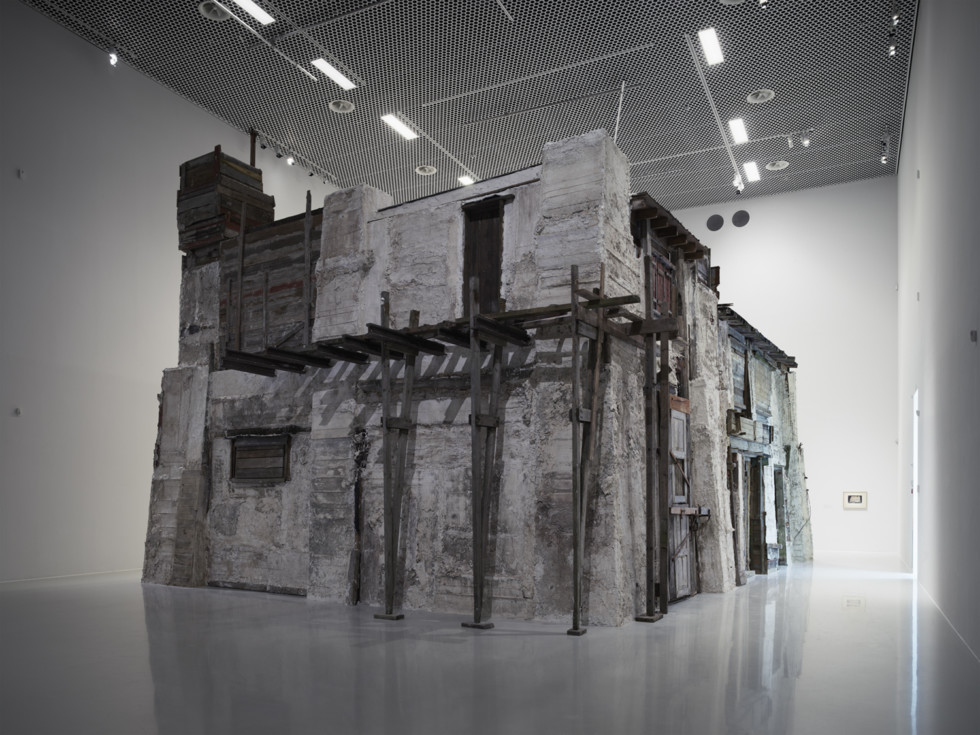
John Skoog i samarbete med/in collaboration with Laslo Chenchanna, Julian Ernst, Gabriel Karlsson, Erlend Rødsten, Søren Schwarzberg, Ernst Skoog, Installation view with "Svalebo" in REDOUBT, 2026 Photo: Peo Olsson/Moderna Museet
How Do We Build Safety When the World Trembles?
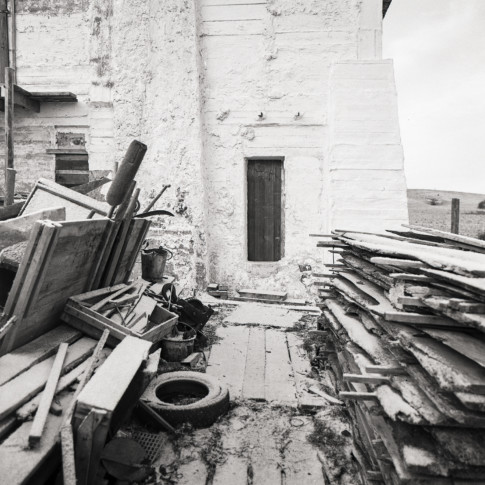
Karl-Göran Persson (1894–1975) sensed the war drawing near. He transformed his home into a protective redoubt — for himself, for the village, and for the king. Once a modest dwelling in a field outside the Scanian village of Hörby, it now stands as the reinforced remains of a fortress.
The work began in the 1930s but gathered real momentum in 1943, when the civil defence pamphlet If War Comes was distributed for the first time to households across Sweden. Construction continued through the tensions of the Cold War until Persson’s death in 1975.
Karl-Göran Persson collected scrap metal from nearby farms — tools and objects discarded in the transition to more mechanised agriculture. He dragged the material home by bicycle and cast it into the concrete as reinforcement.
Gradually, the house was encased in a grey-white shell of masonry, where obsolete farming implements, bicycle parts, and milk churns still glimmer — like fossils from an earlier society.
Svalebo (Swallow’s nest)
In the exhibition REDOUBT at Moderna Museet Malmö, we encounter Karl-Göran Persson’s brutalist structure as a monumental sculpture. Eleven metres long and five metres high, it towers in the Turbine Hall — silent and heavy, bearing the sealed fear of a war that never came.
The sculpture is titled Swallows’ Nest — a name in which solidity and weight give way to an unexpected lightness. Swallows build their nests close to human habitation, where predators keep their distance. The labour is painstaking: small pellets of mud are gathered from ditches, puddles, and fields, carried back to the nesting site, mixed with saliva, and fixed one by one into a natural masonry. Here, a parallel emerges with the way Karl-Göran Persson gathered and hauled materials home — constructing his fortress piece by piece.
Swallows’ Nest was created collaboratively by John Skoog and his fellow artists Laslo Chenchanna, Julian Ernst, Gabriel Karlsson, Erlend Rødsten, Søren Schwarzberg, and Ernst Skoog. Conceived initially as a set for the feature film REDOUBT, it evolved into a collective artistic inquiry. Persson’s idiosyncratic building techniques sparked fascination. The objects sealed within the structure bear the sediment of modernity’s upheavals — shifting relations between humans, other animals, and the landscape. Here, fear — intimate and collective alike — has been poured into concrete, and the solitude of a life lived at the margins has set, irrevocably, into stone.
The Children’s Gaze
In dialogue with the sculpture, the film “Eklipsis” unfolds. Karl-Göran Persson is almost absent; instead, we move among the children— their gaze resting on him and on his work on the redoubt. The Scanian farmland stretches out before us. We find ourselves in a time that is no more — and yet we recognise it: children, then as now, watching the adult world as it seeps into their play
We cycle to his fortified house. We stop a little way off. He likes it when we’re there. He builds and builds. It’s like a swallows’ nest. Almost. (from the film Eklipsis)

Persson belongs to the community and yet stands at its threshold. His fear of war and his stubborn care are sustained by a rationality that also harbours something more fragile, more untamed. To many, his actions seemed exaggerated, even irrational. But what, then, is a measured response to the threat of war? And what is war, if not the collapse of humanity itself — and of reason?
In the film, illustrations from the 1943 civil defence pamphlet flicker past: shelters, protective stances, the coded meanings of sirens. A radio clutched in the hand; a gas mask drawn over the face. Persson studied his copy closely, and Söderto Fortress became his answer — cast in concrete.
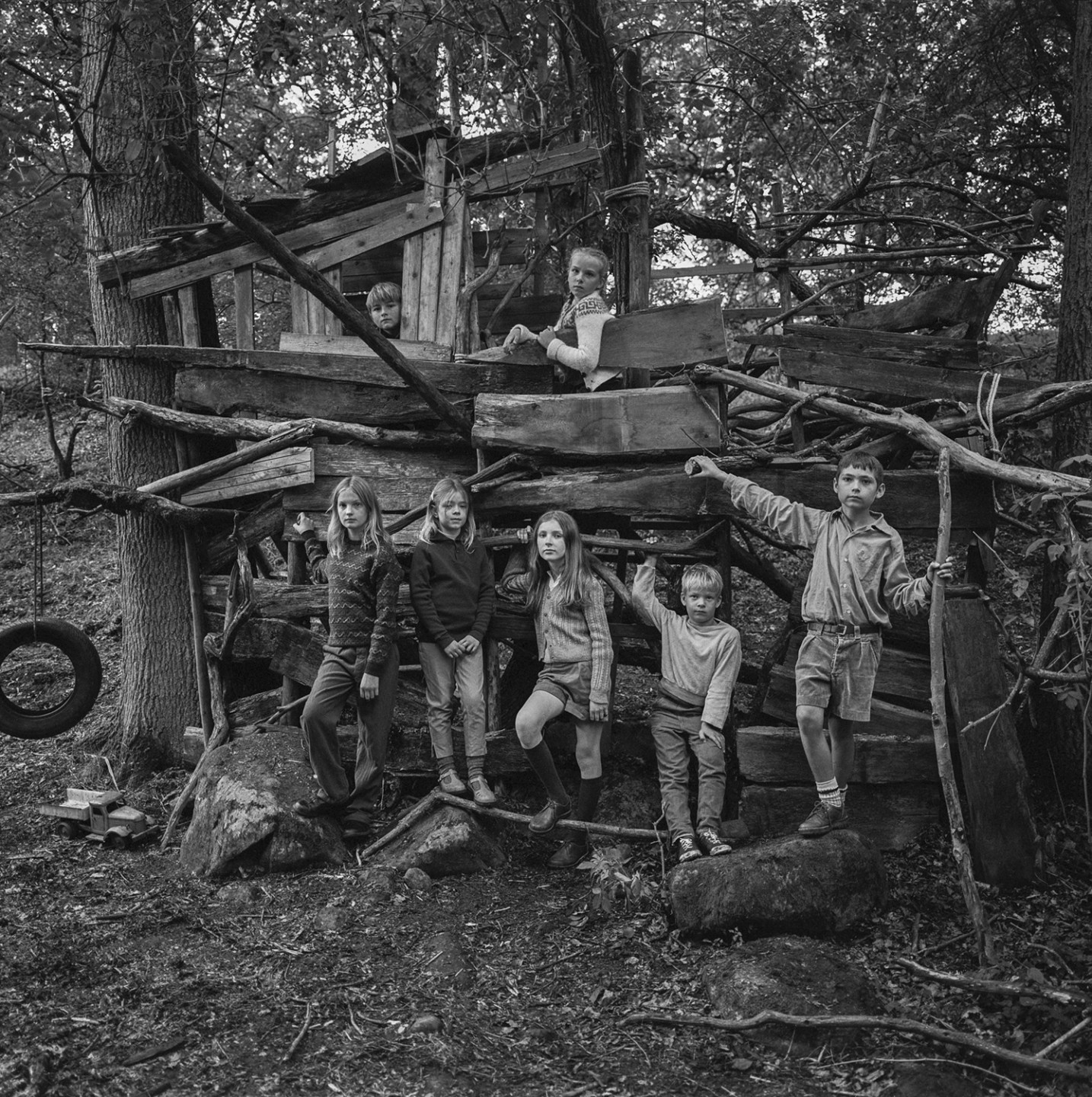
The children follow his work with grave attention. The bunker seeps into their den-building; anxiety turns to play — in deadly earnest. They offer what they can, breaking objects to provide material. Unlike the adults, they understand the impulse: to shield, to care.
Late on Earth
Twilight recurs throughout John Skoog’s artistic practice, and he repeatedly returns to the region where he grew up — the agricultural landscape of Scania.
The darkness drawing in over the fields is foreboding — a danger, a sweeping transformation — sensed yet still intangible. In the half-light, other thresholds open: between rationality and something more unruly, between play and gravity.
At one point in the film, the darkness becomes palpable. A child’s voice recounts how the entire village gathers by the church to witness a solar eclipse, and how Karl-Göran Persson interprets the absence of light as the coming of war.
The birds fell silent. Someone shouts, “The war is coming!” It’s Karl. He’s running towards us, stumbling in the dark. Everyone stares at him. (from the film Eklipsis)
Inspired by Karl-Göran Persson’s redoubt, the children build their own fort from sticks, planks, and thick branches. As they work, they speak to one another in hushed tones, as though careful not to draw the enemy’s attention. Then they line up before their shelter. They lift their gaze toward us — confronting the adult world’s failure to secure a safe and reasonable future.
the Burning Hope
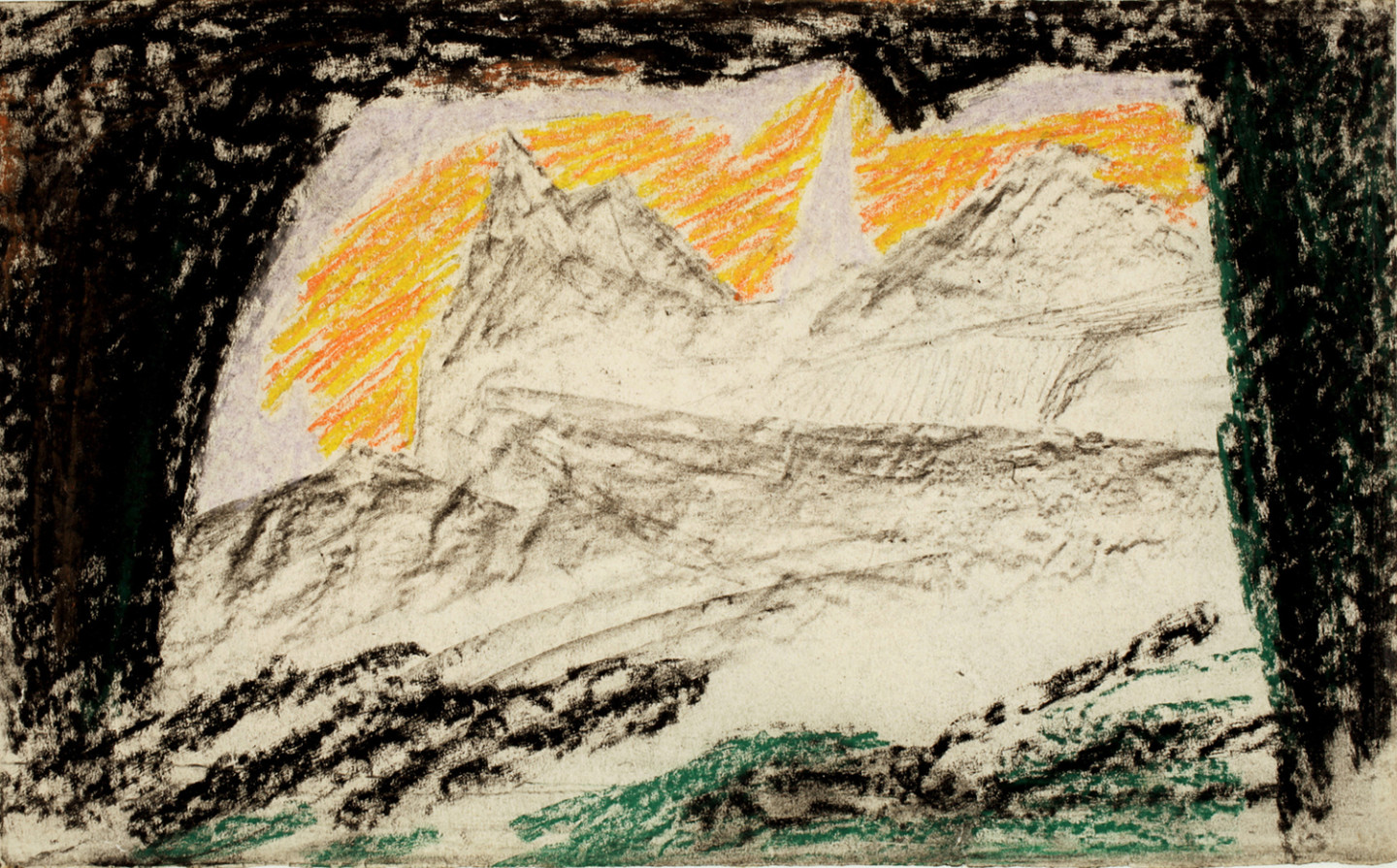
In the making of REDOUBT, the work of Carl Fredrik Hill (1849–1911) — particularly his cave motifs — has remained a quiet point of orientation. Hill’s art binds acute sensitivity to creative radicality — a struggle at once with and for the world.
The cave recurs throughout Hill’s work. In the exhibition, it sets in motion charged and at times disorienting shifts between fortress, hut, cave — and sculpture. Within these shifting forms lingers a quiet yet indomitable hope: a sudden glint of light across the sky, a vista opening over the landscape, a fruit tree enclosed within stone and nonetheless in bloom.
Spanning fifteen years, REDOUBT rests on a quiet trust, visible in its insistence on working and standing together. How is cohesion forged in a rural place, or in a wider society? How do we practise care, make room for belonging, and root ourselves in the landscape that sustains us? How can difference endure without severing the bonds between us? These questions accompany John Skoog — as filmmaker, artist, and human being — and continue to shape the work in Karl-Göran Persson’s footsteps.