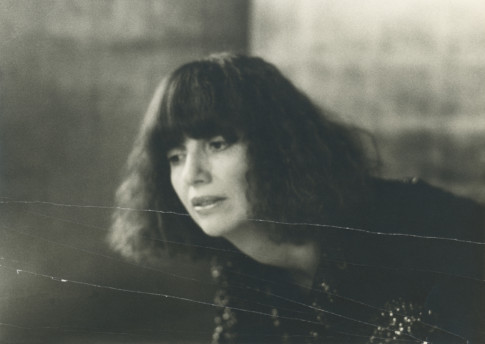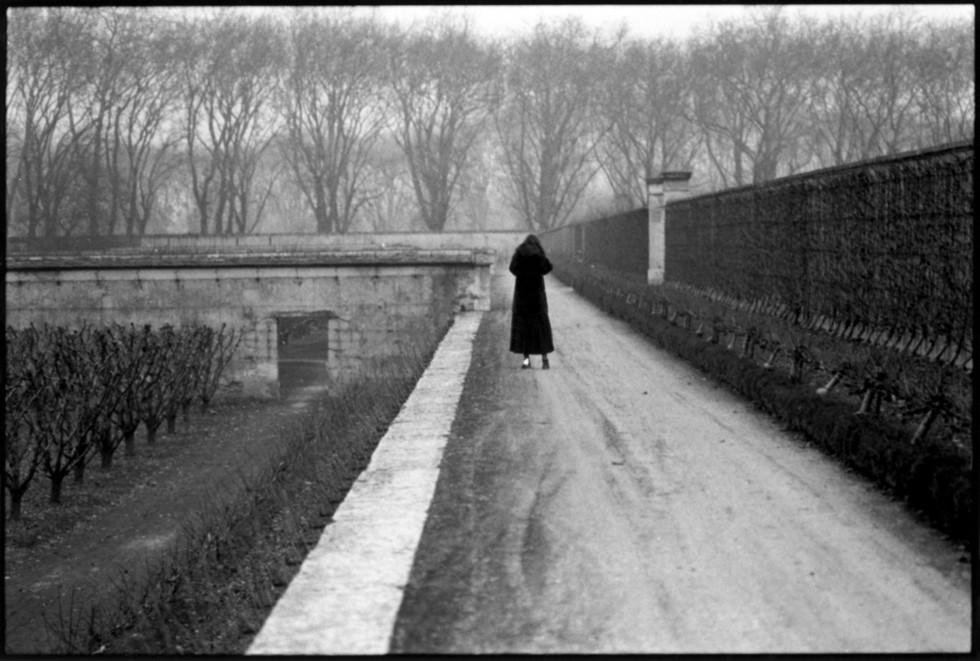
Deborah Turbeville, At Versailles (Self-Portrait), from the series "Unseen Versailles," Versailles, France, 1980 Courtesy of MUUS Collection © Deborah Turbeville/MUUS Collection
The Pictorial Impulse of Deborah Turbeville
By Anna Tellgren
Deborah Turbeville (1932–2013) is best known for her fashion imagery, which has earned her a prominent place in the history of fashion photography. She is mentioned in conjunction with photographers such as Guy Bourdin, William Klein, Sarah Moon and Helmut Newton, all of whom came to the fore in the 1970s and who altered and challenged the conventions of fashion photography[1].
It is likely that the many articles on and interviews with Turbeville reflect her press contacts. In them recurs the theme of how she broke one of the most sacred rules in photography, that of using sharp focus. Instead, she worked with blurry and overexposed fashion photographs in which the models showed emotion and bodily imperfections. Also frequently mentioned is her time as fashion editor at Harper’s Bazaar, where she worked with some of the most famous fashion photographers, but never got the pictures she wanted. She also discloses that she in 1966 was admitted to Richard Avedon’s and Marvin Israel’s workshop for young photographers, despite the fact that she had never worked as a photographer. Her anti-aesthetic approach is mentioned, and how she found a following with her brand of off-colour photography that ranges from brown, cream and beige to soft pink. She speaks about her method and her projects, and she kept returning to the fact that she was not a fashion photographer, nor was she a photojournalist or portrait photographer. Surrealism is another recurring theme. Her role models included photographers such as Brassaï, Jacques-Henri Lartigue and August Sander; paintings and, especially, film were her most important sources of inspiration[2]. Turbeville’s aesthetic expression was in other words far from the sharp, perfect, heavily edited, multicoloured fashion photographs that are shot in a studio. She was more interested in telling stories, which she did through her books.
Turbeville’s first book, Wallflower (1978), was published after she had worked as a photographer for over ten years. It was produced in collaboration with the legendary photographer, painter, teacher and art director Marvin Israel. The book includes several previously published commissions that were compiled and reframed as stories. The title refers to a small, orange flower that grows wild in stone walls; it can also be interpreted as a person who chooses to be, or ends up, on the outside of a group of people. These appear to be the qualities Deborah Turbeville associated with as a photographer. Interestingly, Israel also collaborated with, and worked on photobooks by, Diane Arbus and Lisette Model, two of the most influential women photographers at the time[3]. All three photographers documented and found unusual, sometimes eccentric, people and settings associated with their own experiences and unique perspectives.

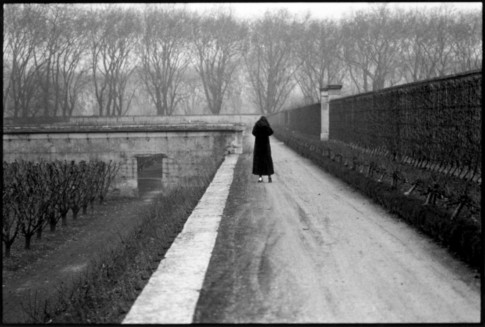
Three years later, Turbeville published Unseen Versailles (1981), for which she was given permission to photograph the smaller, private back rooms. The most impressive aspect of this is perhaps that it was Jacqueline Onassis, then editor at the publisher Doubleday, who through her contacts opened the doors to the forbidden parts of the palace. Then came Newport Remembered (1994) about the forgotten resort where the American upper crust constructed their lavish summer palaces at the end of the 19th century. Both books include well-informed texts by the American lawyer, historian and author Louis Auchincloss. Turbeville completed her trilogy about abandoned historic places with a volume on tsarist Russia. Studio St. Petersburg was published in 1996 after she had visited the city over a period of two years. In these books she recreated the milieus and brought them to life by placing models and objects in the rooms. As a result, the images are more than just photographic documentations of architecture and old buildings.
The attraction of Deborah Turbeville’s work is the secretive imagery she created in suggestive settings populated by beautiful, enigmatic figures. Her aesthetic approach shows interesting similarities with Pictorialism – an -ism that is only found in photography – and the way it has been perceived and discussed. Pictorialism developed from the end of the 19th century up until World War I and was inspired by Impressionism, Symbolism and naturalism, placing the emphasis more on the optical and pictorial, rather than the photographic, qualities of an image[4]. It was the first international art photography movement to have a large number of prominent practitioners across Europe and the United States. Clubs were formed to promote this new form of art photography, among them were the Wiener Camera-Club (Vienna), the Photo-Club de Paris and the Photo-Secession in New York, with famous members such as Gertrude Käsebier, Edward Steichen and Alfred Stieglitz. The works were judged in competitions as well as shown in galleries, museums and international salons. The style thus spread to the Belgium, Italy, Netherlands, Poland, Russia, Spain, and the Nordic countries[5]. As these photographers met and got to know one another, a photographic community was formed within the movement.
Pictorialism took a different direction from amateur and professional photography. The Pictorialists used various processing methods and materials, some of which were closer to those of printmaking and painting, and they avoided regular photographic materials. The craft of making photographs was important to them, an approach that was in line with an interest in and revival of older techniques as industrialism gained momentum during the period of Jugendstil in Europe, around the turn of the twentieth century. Instead of using the most common type of photo paper, with a coating of silver halogens in gelatin or albumen, Pictorialists used other light sensitive compounds, working with a variety of processes such as gum bichromate, platinum and bromoil printing with the purpose of creating, or “painting”, an image on light-sensitive paper. Bespoke paper used for these methods was marketed by Höchheimer, Bühler and Fresson, among other companies. Pictorialists’ images are characterized by soft focus and often a grainy, print-like texture in hues that range from earthy browns to vibrant reds and blues. Portraiture was the genre that featured the stylistic tenets of Pictorialism the longest, until the 1930s, but a vast number of subjects also consisted of landscapes, cityscapes, dancers, fashion and nudes.
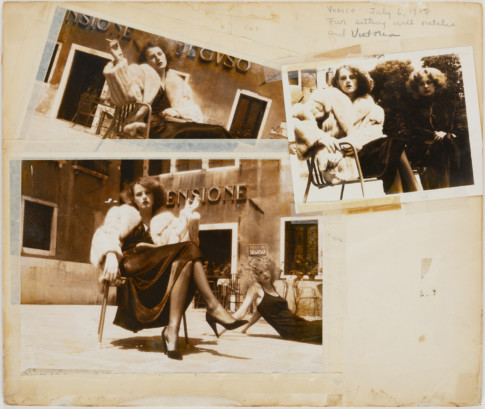
We find all these motifs in Turbeville’s work, and her way of starting out in sharp focus and then gradually blurring the picture is in line with Pictorialist aesthetic principles. She was a highly skilled printer, and she often worked with unusual types of paper, she experimented with toning and unconventional processes, she even scratched the negatives when working with her fashion photographs, collages and photographic objects. In her collages she combined images from different series by cutting, taping or pinning them to handmade papers with an unerring eye and sense of form. Sometimes she mounted her work in broad wooden frames, sometimes she nailed larger prints directly on walls covered in wrapping paper. This too evokes the Pictorialists, who exhibited their work in dark, ornate wooden frames, often hung in congested showrooms. Deborah Turbeville connects back to these technically skilled photographers who were active around 1900, who with great care and an impeccable feeling for the materials debated the principles of composition and the nature of pictorial or artistic photography.
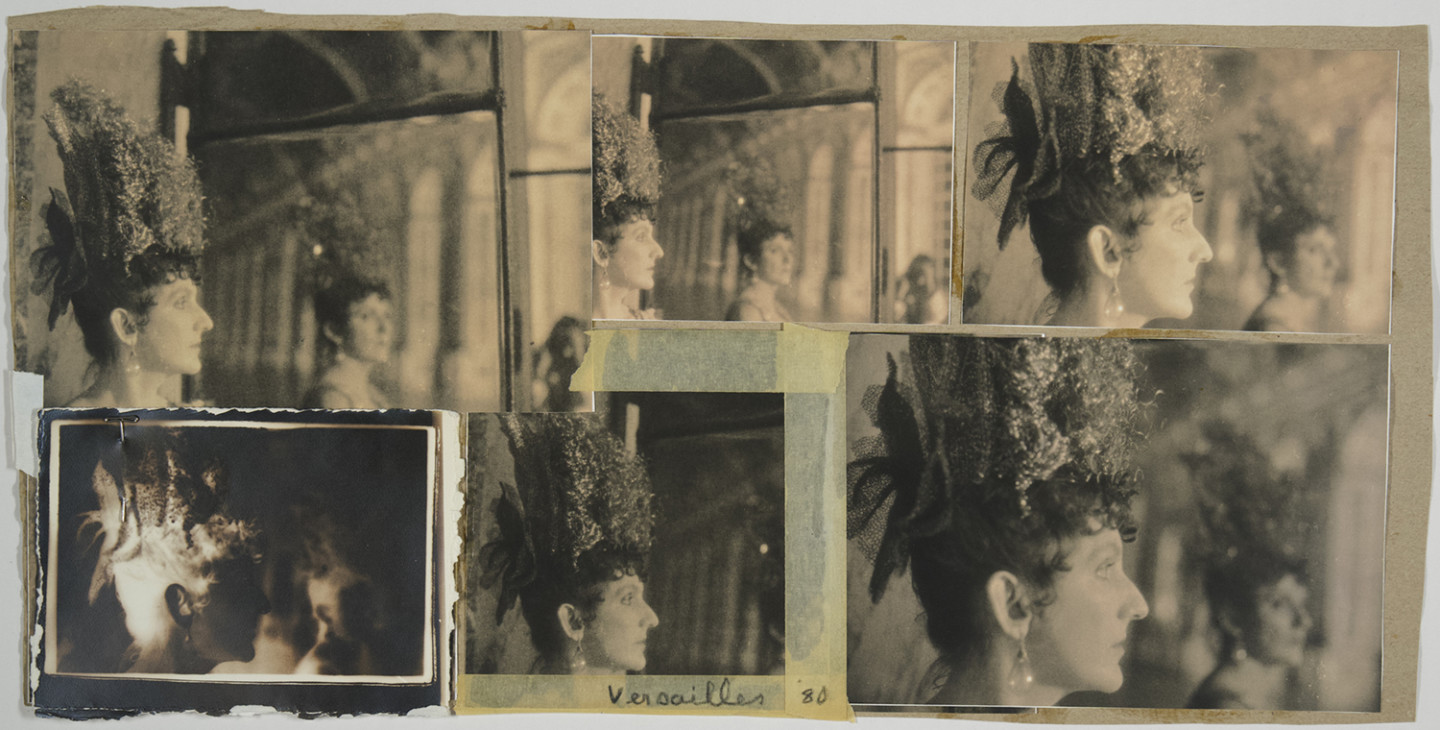

In a long and comprehensive interview published in the periodical Artograph in spring 1982, Turbeville mentioned several aspects of her work and her views on photography. It made her sad, she said, when people compared her work to that of soft-focus photographers: “I try to make the soft-focus and the grains and the texture work in a kind of perverse, strange, eerie way, not in a romantic way. I don’t like being called a romantic photographer”[6]. Although not mentioning it explicitly, this brings Pictorialism to mind. Her statement evokes the way participants in the debate on Pictorialism rejected the idea that their pictures were “blurry”, preferring the term “soft focus”.
In the history of photography, Pictorialism has been described in more negative terms than the New Objectivity, which came to the fore in the early 1920s with close links to modernism. Because the history of photography, in the beginning, often was written by the photographers themselves, there has been great emphasis on their own careers and affiliations. Contrary to the arranged, soft-focus style, photographers within the New Objectivity movement worked in a clean, minimalistic tradition and celebrated high contrast, precision and unconventional angles. The distinctive character of the photographic medium, rather than the painterly elements, was paramount. Pictorialism was considered hopelessly old-fashioned, a notion that perseveres to this day. But if you dig deeper, you can discover treasures of images as well as interesting discussions on art and photography. There is therefore more than one good reason for incorporating Deborah Turbeville in this tradition. As we have seen, she repeatedly insisted on not being called a fashion photographer and that she resisted labels, she preferred to work freely on her multi-layered photographic stories.
From the 1970s onwards, Deborah Turbeville belonged to a group of well-known photographers. Her work was shown at a number of gallery exhibitions, in photobooks and in newspapers and magazines. One of the many young photographers who was inspired early in her career by Turbeville’s innovative, evocative fashion photography was Francesca Woodman, who when she moved to New York after completing her education among other things tried her hand at fashion photography, among other things[7]. These trials include some of Woodman’s few colour photographs, a series of eight, but none of these, or any of her other fashion photographs, was ever published. However, there is a connection between the two women consisting in their mutual interest in architectural detail and the eery, abandoned locations that are prominent in several of Woodman’s series.
More than ten years after Deborah Turbeville’s death, her photography has yet again come into focus. The unpublished portfolio “Passport” – about the iconic fashion editor Diana Vreeland, who employed the young Turbeville in the early 1960s – has been rediscovered and shown[8]. Contemporary photographers and artists now move effortlessly between social media platforms at the same time as many of them are rediscovering older, analogue techniques, publishing artists’ books and creating installations and photographic objects. This means that many of Turbeville’s practices are timely as well as a reminder of the fact that history always repeats itself, but in a slightly different way. We now look forward to a new post-Pictorialism that would take inspiration from Deborah Turbeville and her intriguing photographic universe.
Anna Tellgren holds a PhD and is Curator of Photography and Head of Research at Moderna Museet in Stockholm. The text is included in the book “Deborah Turbeville – Photocollage”, edited by Nathalie Herschdorfer, published by Thames & Hudson in 2023.
Footnotes
[1] See for example Françoise Ducros, “The Dream of Beauty. Fashion and Fantasy”, A New History of Photography, ed. Michel Frizot, Köln: Könemann, 1998, pp. 551–553. Deborah Turbeville was also included in Nancy Hall-Duncan, The History of Fashion Photography, New York: Alpine Book Company, 1979.
[2] See “An Interview with Deborah Turbeville”, Artograph, New York: Baruch College Art Department, no. 3, spring 1982, pp. 2–3. She mentions film directors including Michelangelo Antonioni, Ingmar Bergman and Federico Fellini.
[3] Diane Arbus Magazine Work, ed. Doon Arbus and Marvin Israel, New York: Aperture, 1984; Lisette Model. An Aperture Monograph, design by Marvin Israel, New York: Aperture, 1979; Deborah Turbeville, Wallflower, ed. Kate Morgan and Marvin Israel, New York: Congreve Press, 1978.
[4] See Impressionist Camera. Pictorial Photography in Europe, 1889–1918, ed. Philip Prodger, London/New York: Merrell Publishers Limited, 2006.
[5] For Pictorialism in the Nordic countries see: Tove Thage, Pictorialisterne. En fotografisk kunst uden for akademierne, Skive: Forlaget Wunderbuch, 2020 (Denmark); Piktorialismi. Valokuvataiteen Synty, ed. Sofia Lahti and Jane Vuorinen, Helsinki: The Finnish Museum of Photography and Parvs, 2022 (Finnish, with English summary); Waldemar Eide. Kamerakunst, ed. Vibece Salthe, Stavanger: Stavanger Kunstmuseum, 2016 (Norway); Anna Tellgren, “Between Pictorialism and New Objectivity”, Swedish Grace. Art and Design in 1920s Sweden, ed. Cilla Robach, Stockholm: Nationalmuseum, 2022, pp. 91–103, 121.
[6] “An Interview with Deborah Turbeville”, Artograph, no. 3, 1982, p. 3.
[7] See Anna Tellgren, “Francesca Woodman On Being an Angel”, Francesca Woodman. On Being an Angel, Stockholm: Moderna Museet and London: Koenig Books, 2015, pp. 5–16. See also Alison M. Gingeras, “Francesca Woodman: Another Almost Square, A Fashion Photograph”, Francesca Woodman. I’m Trying My Hand at Fashion Photography, New York: Marian Goodman Gallery, 2015, pp. 4–15.
[8] “Passport” was shown at Paris Photo 2021, curated by Nathalie Herschdorfer for MUUS Collection, which in 2020 acquired the Estate of Deborah Turbeville. The project has been mentioned, for example, in an article by Thessaly La Force, “Deborah Turbeville. A Passport to Fashion”, Aperture, no. 249, pp. 68–77, 2022. It was exhibited as early as in November 1995 at Fotomässan (the Photofair) in Gothenburg, see “Bildgalleri”, Fotografisk Tidskrift, no. 5–6, 1995, pp. 22–23. The exhibition Deborah Turbeville. Studio St. Petersburg followed in 1997 at the Hasselblad Center in Gothenburg, curated by Hasse Persson, photographer and from 2002 to 2005 artistic director of Hasselblad Center.