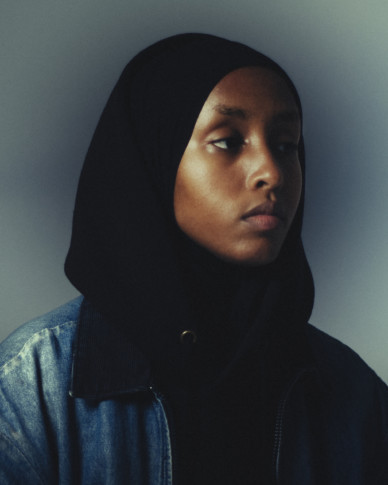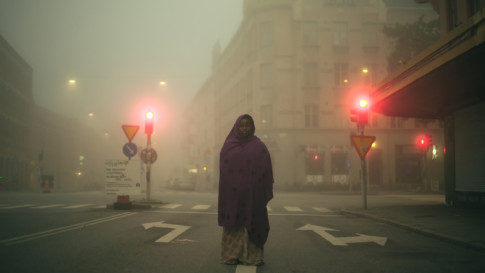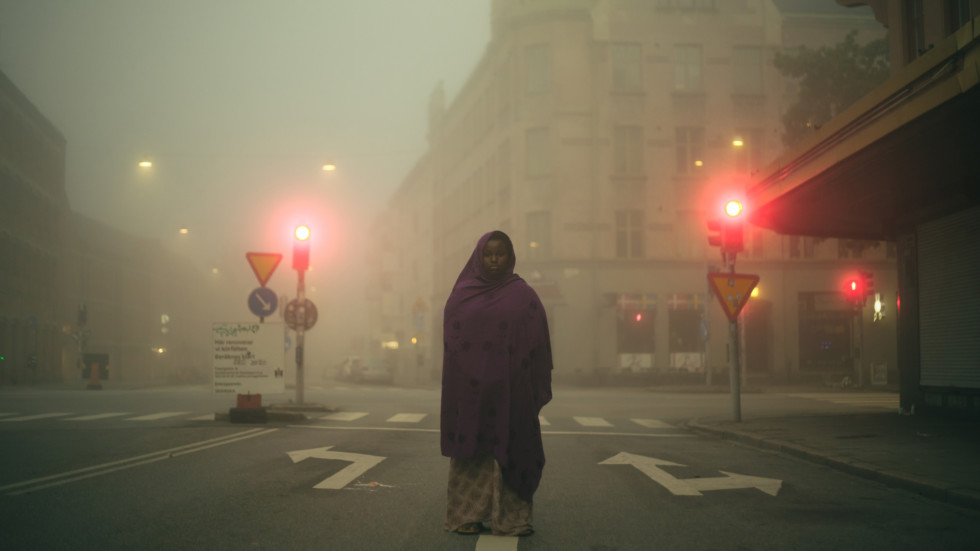
Ikram Abdulkadir, Subax Aliseey, 2020 © Ikram Abdulkadir Bildupphovsrätt 2026
Anna Tellgren on Ikram Abdulkadir
She belongs to a younger generation of photographers who work with lens-based art and move freely between different digital platforms, still and moving images, exhibitions and different publication formats.
Ikram Abdulkadir was born in 1995 in Nairobi to Somali parents and grew up in the Rosengård district of Malmö. In high school, she bought a camera and began to take photographs, publishing her photographs on her Instagram account @ikramisanism, which quickly captured an audience and led to several fashion and portrait commissions. She has photographed such popular figures as Cherrie, Molly Sandén, Seinabo Sey, Stellan Skarsgård, and Timbuktu, and she was hired for the official portrait of the 2026 Hasselblad Award Winner Zanele Muholi. Since her debut, she has had solo exhibitions in Malmö, Stockholm, Norrköping, and Copenhagen, and during the summer of 2023, she participated in the group exhibition Sisterhood – Contemporary Nordic Photography at the international photography festival Les Recontres de la Photographie in Arles, France.
Abdulkadir’s breakthrough came with the series We Will Meet Again in Paradise, which was displayed in her first solo exhibition in 2020 at Skånes konstförening in Malmö when she had received Sven and Ellida Hjort’s Exhibition Grant. With her sisters and their friends moving before the camera in long, white, loose-fitting dresses (jalabib), she created a series of photographs that radiate joy and strength. The series is suggestive of religious ceremony, a ritual, but was intended as a tribute to earlier generations of women in the family. The images in We Will Meet Again in Paradise have appeared in many different contexts and have been imitated by other fashion photographers. In this exhibition, we see two portraits from the series, sister Salma photographed both in profile and directly from the front. Here, Abdulkadir has chosen to crop the motif strictly to give a more austere impression than the more dynamic full-body images. In the same year, 2020, she began the still-ongoing series I See Home In You, which develops her interest for community, caregiving, and love. Through the constant flow of images from life in and around Möllevången in Malmö, the series functions as a sort of batch of diary entries, or an intuitive method of documenting and testing ideas. In this, Ikram Abdulkadir engages with a long tradition in which photographers have lived with their cameras in hand and documented an environment, a context, a group of people they belong to and know well.
Another acclaimed series is Do You Remember the Ocean, Abaayo? which was also published in an artist’s book from 2021, with a short text by the photographer. In this series, she employs words and pictures to capture and communicate a summer in the height of the pandemic where she and her sisters went on an outing to some of the Scanian beaches near Malmö. She reflects on her own relationship to the ocean and thinks about her father’s stories about his childhood in Somalia. With this visit, she wanted to create her own summer memories for herself and her sisters. “Abaayo” means “sister” in Somali and is often used as a way of addressing close female friends. Also a poet, Ikram Abdulkadir moves between Swedish, Somali, and English in her texts. Already at seventeen years old, she participated in The Region’s Best Poet competition, organized by the association Förenade Förorter (United Suburbs), and advanced to the final in Rinkeby with the poem “Free Birds.” Literature, with the Somali poetic tradition in particular, has been a meaningful inspiration and has also shaped her political engagement against injustice, abuses of power, and cultural segregation.
In connection with the large-scale Swedish Acquisition 2021 project, the time during the pandemic when the Swedish government allocated Moderna Museet additional funds to support the art sector in Sweden, Ikram Abdulkadir was one of the 169 artists whose works were acquired for the museum’s collection. In the collection is the portrait Dabeesha (2021) with Abdulkadir’s little sister Salma, one of her favorite models, placed before the wall of a building. The thin brown veil flutters in the wind and conceals the young woman’s face. “Dabeesha” means “wind” in Somali. At the same time, the work Amo Fågel (2021) was also acquired, in which an older man in a light blue shirt is standing on a sidewalk and feeding the pigeons that are flocking around him. Ikram Abdulkadir describes her path to photography as beginning with the purchase of an analog camera on the internet marketplace Blocket, and she began photographing buildings and landscapes. She is self-taught and has no artistic training, she taught herself the craft, the photographic techniques, through videos on YouTube and by testing out ideas. She soon found it too limiting and uninteresting to photograph buildings; encounters with people were much more engaging. Urban milieus can be seen in almost all of the different series she has worked with, however, as well as in portraits, for example in the acclaimed artist portrait of Malmö-based rapper Ozz6y for his debut album An Eye Red from 2018.
For the exhibition Soft Focus at Moderna Museet Malmö, Ikram Abdulkadir has searched her immense archive of photographs, which today contains thousands of pictures, and picked both new and old works that juxtapose against each other and emphasize central themes in her art. In many of the motifs, we gain glimpses of her family and her friends, both at home and out on the city’s streets and squares. Her use of colour is another feature that distinguishes her work, and she uses a palette that spans from muted green, blue, and brown hues to stronger signature colors of red, pink, and purple. Technical mistakes such as double exposures and overexposures are employed, making the motifs mysterious and captivating. She experiments with different sizes and displays certain images as wallpapers that cover entire walls in the exhibition space, but also includes framed photographs in mid-size format and, in a more classical small format, her black-and-white photographs, mounted in passepartout and black frames. There is something dreamy about the images, an intimacy, but also a feeling of intense care in the works; she has been called a pictorial poet and her photographs have been called pictorial poems.
In dialogue with Ikram Abdulkadir’s photographs, we are showing the exhibition Photocollage with American photographer Deborah Turbeville (1932–2013) who began her career in the mid-1960s as a fashion photographer and later developed an individual and artistically-inclined photographic approach. Through the years, she received commissions for several famous designers and for many of the big fashion magazines. She traveled between and worked in New York, Paris, Mexico, and Saint Petersburg. In the exhibition, we present a selection of Deborah Turbeville’s oeuvre, from the expressive fashion photographs to the unique photo collages she created using paper. Here, we see distinct connections to the photo culture of today in which “materiality” has become a central concept, a consequence of the total eclipse by digital technology including social media and now AI that we all live with and are impacted by. Many contemporary photographers have returned to analog technology and work with film negatives, presenting their works as prints, as objects in different types of installations.
When it comes to both of these photographs, we can also draw the threads back in photographic history to pictorialism, one of the first international art photography trends that grew forth from the end of the 1800s and on to World War I. The movement had many outstanding practitioners around Europe and the USA, and they worked with a variety of different processes and materials, where some of the techniques moved away from their photographic origins and approached graphic art and painterly expressions. The Pictorialists’ images are identifiable by what is known as “soft focus” and often rough, graphics-like surface in a color scheme that ranges from brown, earthy tones to strong hues of red and blue. Within this movement, intense discussions went on around different stylistic methods and the relationship between art and photography. The genre of the portrait was where pictorialism’s ideal lingered the longest, into the 1930s, but among the motifs we also frequently find landscapes, urban scenes, dance, fashion, and nudes. In Deborah Turbeville, we find all of these, and her method of photographing first with a sharp focus and then gradually less focused lies in line with the pictorialist aesthetic. In Ikram Abdulkadir’s work, too, we find several of these timeless motifs, and her method of testing her way forward, experimenting with color, form, light, and shadows that hide and erase guide our thoughts to pictorialism. In all parts of her photography, from the commercial assignments to her own projects, her interests and knowledge from music, film, poetry, and fashion find expression. The exhibition Soft Focus is the continuation of the photographic journey that Ikram Abdulkadir began a decade ago, and one of the many chapters in her personal story of living and working in a Sweden that is constantly changing.
Anna Tellgren holds a PhD and is Curator of Photography and Head of Research at Moderna Museet in Stockholm.
Svenska förvärv 2021/Swedish Acquisitions 2021, eds. Asrin Haidari, Fredrik Liew, Andreas Nilsson, Anna Tellgren, and Gitte Ørskou, Stockholm: Moderna Museet and Art & Theory Publishing, 2024.
Deborah Turbeville Photocollage, ed. Nathalie Herschdorfer, London: Thames & Hudson, 2023.
Søsterskap (Sisterhood) – Contemporary Nordic Photography, Objektiv #27, Oslo: Objektiv Press, 2023.
A World History of Women Photographers, eds. Luce Lebard and Marie Robert, London: Thames & Hudson, 2022.
Fotografihistorier. Fotografi och bildbruk i Sverige från 1839 till idag (Photography Histories. Photography and the Use of Images in Sweden from 1839 to Today), ed. Anna Näslund Dahlgren, Stockholm: Natur & Kultur, 2022.
Another Story. Photography from the Moderna Museet Collection, ed. Anna Tellgren, Stockholm: Moderna Museet and Göttingen: Steidl, 2011.
Impressionist Camera. Pictorial Photography in Europe, 1889–1918, ed. Philip Prodger, London/New York: Merrell Publishers Limited, 2006.
Women Photographers – European Experience, eds. Lena Johannesson and Gunilla Knape, Acta Universitatis Gothoburgensis, Gothenburg Studies in Art and Architecture no. 15, Göteborg: Hasselblad Center, 2003.